What nobody tells you about selling your parents' house — without getting ripped off, fighting your siblings, or going broke. 150 pages. PDF, delivered the moment you finish checkout.
Every figure in the book is independently source-verified. Here are the three that anchor everything else.
"The average adult settling a parent's estate spends 420 hours doing it over an 18-month stretch, and almost none of those hours involve anything they were prepared for in advance."
Sources: Empathy.com 2024 Cost of Dying Report (n=2,000 Americans, partnered with Goldman Sachs) and Clever Real Estate's 2024 survey of 764 active residential investors, corroborated by a Drexel University study of 3,900 Philadelphia transactions.
On a $400,000 inherited home, the gap between a typical cash-buyer offer and a normal market sale runs $50,000 to $120,000. The book is $49.
Someone you loved is gone. The casseroles in your fridge haven't gone bad yet. There's a house somewhere — maybe a town you haven't lived in since high school, maybe the one you're sitting in right now.
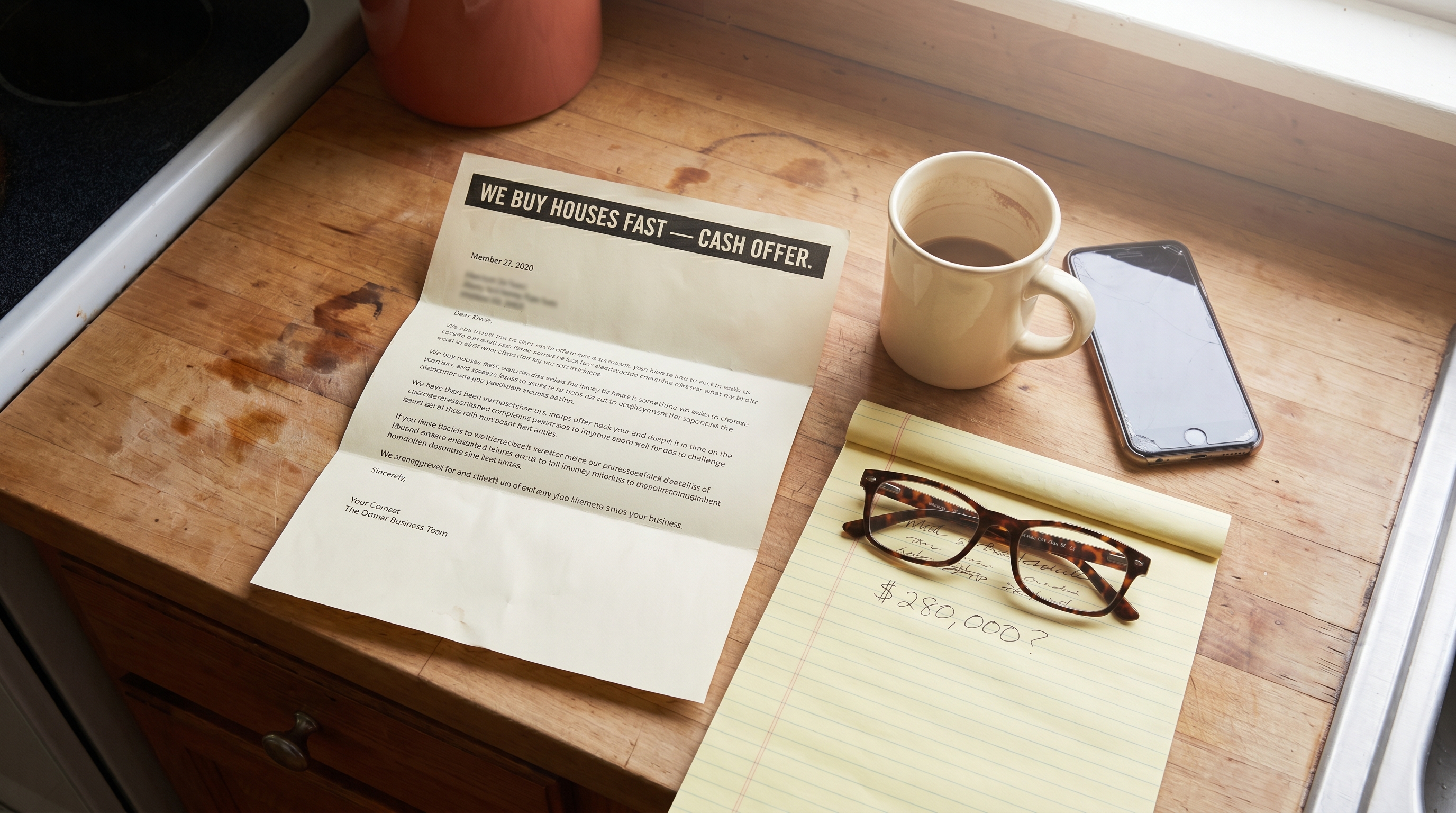
A cash buyer is already in your inbox. They got the obituary before you got the casseroles. They're offering to close in ten days.
The sibling who promised to help is not picking up the phone. The realtor your neighbor recommended has never done a probate sale before. The mail is starting to arrive, addressed to a person who isn't here.
You are not behind. You are exactly where everyone is at this point. Nobody trains you for this. The 420 hours, the $12,616, the eighteen months — that's the default. The people on the phone with you have done this a hundred times against your zero.
This book is the version of the next nine months you didn't have on day one.
I'm not a probate attorney. I'm not a realtor. I'm a publisher who has watched this same scene play out from too close a distance — three times in four years, with three different friends, in three different states.
Two of them out-of-state. One of them sold to a cash buyer in week three and is still upset about it two years later. None of them had a book like this on their kitchen table when the calls started coming.
So I built the one I wished they'd had. The Inherited Home Survival Guide is one hundred and fifty pages of the playbook nobody hands you with the death certificate.
The credibility part matters, so here it is up front. The chapters covering law and tax are fact-checked by a practicing real estate attorney before anything ships. The chapters on selling — the cash-buyer trap, the as-is decision, the realtor interview — are reviewed by a CPRES-credentialed probate-specialist realtor, the designation that matters in this niche. I name them on the copyright page once the reviews are final.
I'm also telling you what I'm not. I'm not your attorney. I'm not your CPA. There are points in this book where the answer is "stop reading and call a probate lawyer," and the book is honest about which points those are. Chapter 6 is half decision tree.
A lot of pieces of a parent's estate can wait. Going through their clothes can wait. The Costco membership can wait. The final tax return can wait until April. The house is the one piece that has clocks running on it — property taxes, insurance, utilities, the IRS step-up basis window, and a quietly accumulating list of people who want to buy it from you for less than it's worth.
Sell now, sell later, rent it, or keep it. The math on each, the family conversations that come with each, and the order to do things in so you don't accidentally close a door you wanted to keep open.
First week. First thirty days. The dead zone in the middle of probate. The months around the sale itself. You can read it front-to-back or jump straight to whatever is on fire right now.
Verbatim language for every call you have to make — the bank, Social Security, the IRS, the utility companies, the credit card companies, the pension administrator, the DMV. You read the script. They give you what you came for. You hang up.
Not legal advice. Not tax advice. Not a grief book. It's the playbook a friend who's been through this twice would write down for you if they had a weekend free.
First week. First thirty days. The dead zone in the middle of probate. The months around the sale itself. You read it in the order the calls come in.
We could fill this page with five-star quotes from "Sarah, 54" and "Katie, 51." A lot of pages in this niche do exactly that.
We're not going to. The first edition of this book is in the hands of beta readers right now — adult children who recently inherited a home and agreed to read the manuscript and write back honestly. Their testimonials will be added here, with real names and real states, before paid traffic scales.
If you're one of the first 50 buyers, you get a 50% lifetime discount on any future Steady product in exchange for honest written feedback after you've read the book. Reply to your receipt email when you're ready.
Until then, the social proof on this page is the kind we can defend: the 420 hours, the $12,616, the 67.5%, and the Reddit voices of people who've actually been through this. Real numbers from real sources. No fake quotes from fake faces.
Chapter 1 opens this way. It's short on purpose. The rest of the book has work in it.
"It's probably late. A parent died — recently enough that the casseroles in your fridge haven't gone bad yet. There is a house somewhere — maybe a town you haven't lived in since high school, maybe the one you're sitting in right now. Someone in your family has already asked what you plan to do with it."
"You don't know what you plan to do with it. That is why you bought this book. Before anything else: that's a reasonable place to be. Nobody trains you for this. You are not behind. You are exactly where everyone is at this point."
"What happened to your parent is grief. It does not respond to checklists. What's happening with the house is a project. It has steps. The mistake almost everyone makes is letting the two get tangled. The book is the project room. The grief room is somewhere else — just as important, but not what you bought this for."
"You're going to want a list of ten things. Here's one. Order a date-of-death appraisal of the house. $400-$700. Seven to fourteen days. It locks in your stepped-up basis for tax purposes — the highest-ROI $500 you'll spend in this entire process. That's today's list. Tomorrow's list is in Chapter 3."
That's how Chapter 1 ends. Fourteen more chapters follow.
The structure follows the timeline you're actually living — first week, first month, the dead zone in the middle of probate, then the months around the sale itself.
The first 48 hours. What you have to do this week (very little). What you do not have to decide yet (almost everything). Why the cash buyer already knows your name.
The most important chapter in the book. The math on a typical cash offer: 67.5 cents on the dollar against ARV. On a $400K home, the gap is $50K-$120K. Plus the one phrase to memorize and the four scenarios where cash actually is the right call.
Death certificates (more than you think), accounts to freeze, mail to forward, and the appraisal that has to be ordered in the first thirty days or you'll owe capital gains on appreciation that happened before your parent died.
Sell now, sell later, rent it, keep it. A worksheet, not a sermon. The math on carrying costs over six months of a vacant inherited home.
The conversation that breaks more families than any other piece of this. How to have it, when to have it, what to say when your brother won't move out. The chapter readers re-read most.
Half decision tree, half plain-language explanation. Scenarios where a $300 attorney consult saves you $30,000. Scenarios where you don't need one at all.
Most realtors have never done a probate sale. The ones who have hold the CPRES designation. What it means, why it matters, and how to interview one.
The single most expensive piece of tax law most heirs have never heard of. Worked examples on a $400K home that show exactly how a tens-of-thousands-of-dollars mistake happens. Read before you sell.
Estate-sale companies. The dumpster math. The things to look for before the dumpster (savings bonds in the freezer is a real category). The digital cleanout almost nobody talks about.
When $4,000 of paint-and-clean returns $25,000 at sale, and when it returns nothing. Open-market as-is discounts run 5% to 25% — the chapter walks you through where you actually fall.
The honest case for and against landlording an inherited home. The tax implications most people miss (you lose the step-up advantage if you hold). The property-manager interview if you go ahead.
The aunt who took care of Dad. The brother who's been "between things" since 2019. The stepparent on the deed. Legal options, conversation scripts, and cash-for-keys math that almost always beats an eviction.
Final accounting. Final tax return. The paperwork that closes probate. The piece nobody tells you about — the year after the sale, when the 1099s show up.
The HOA letter that arrives three weeks after the funeral. The auto-pay on Mom's Costco card still running. The small-claims court summons for a debt you never knew existed. A field guide to the surprises.
The retrospective the book itself can't write. What three friends who've been through this told me they wish they'd known on day one.
The single most-used asset in the book. Verbatim scripts for the bank, Social Security, the IRS, utility companies, credit card companies, the pension administrator, the DMV. Pressure-tested against real institutional language.
Ten questions for any realtor pitching for your listing. Tells you in fifteen minutes whether they've done a probate sale before or are making it up as they go.
Every document you need to gather, in the order you'll need them, with the agency that issues each one.
Six branches. Most readers don't need an attorney. Some readers desperately do. This page tells you which one you are.
$27 value — yours free at checkout, the most-shared asset in the playbook
Most readers email the meeting agenda to their siblings before the conversation. No upsell page, no second click. It's there.
If the book doesn't help, email us within 60 days. We refund the $49. You keep the PDF. No form. No "tell us why." I'd rather refund someone who didn't get value than keep $49 of an inheritance that didn't need this book.
— Tyler, Steady
Questions? Email tyler@inheritedhomesfl.com
Verbatim quotes with usernames and source URLs. Pulled from the Reddit corpus that informed every chapter of the book. Linked in case you want to read the full threads.
"I inherited my grandfather's house in Baltimore. I live in Seattle. A wholesaler offered me $255K cash. My realtor thinks I can list it at $300K. I'm exhausted from flying back and forth. Am I just rationalizing taking the lower offer to make this end?"
— u/retsam2554, r/RealEstateAdvice"I'm exhausted."
That was her entire final sentence after laying out a whole mess about inheriting half a house with her uncle and watching him grind down her share. Two words. Not a paragraph.
— u/CricketKnown352, r/inheritance"My aunt is living in the house for free. She was caring for my grandmother. My grandmother passed ten months ago. We've been floating our own mortgage and bills for two houses the last 10 months. I don't know how to ask her to leave."
— u/scifi-riot, r/legaladvice"My brother moved into our parents' house and won't leave. He's not paying anything. He says it's 'his home now.' Mom died in October. It is now April and I still have not spoken to him."
— u/Bulky-Nectarine-8514, r/AmItheAsshole"All 5 of us won't agree to just giving their stuff away… so it will end up being some sort of fight with what to do with all this. And it's gonna end up on me. And I don't want it. I will be left with nothing but a ton of work."
— r/Millennials"A family friend tried to buy my house for $1 as a joke that wasn't a joke. We politely declined and then promptly went home and screamed into pillows."
— u/Just-zander, r/EntitledPeopleThese are the voices the book was written for. Every chapter is anchored to verbatim quotes like these, with the source URLs in the footnotes. The corpus has the right voice. Now we're building the testimonial set from real Steady beta readers.
There is a version of the next nine months where you make every decision feeling rushed, exhausted, and out-of-your-depth. That's the default. That's the one the cash buyers built their business around.
And there is a version where you have 150 pages of plain-language playbook on the kitchen table, a phone script for every call you have to make, and a sibling toolkit that turns the hardest conversation into a meeting with an agenda. $49.
Get the Survival Guide — $49