
A guy named u/retsam2554 posted this on r/RealEstate three weeks ago. Real post, real account, still up.
He's in Seattle. His grandfather died in September and left him a house in Baltimore County, Parkville area. He has a demanding job he can't step away from. The house is sitting vacant costing him $600 a month in utilities, taxes, and insurance.
He interviewed three local agents. They all said roughly the same thing. Spend $20-25K on repairs, list at $350K, expect a 45-60 day sale, net somewhere around $295-305K after commissions and closing.
Then he got a call from local cash buyers. $255K, close in ten days, buy as-is.
Here is exactly how he wrote the decision out:
"$255k vs $300k (realistic net from traditional sale) = $45k difference. Is $45k worth 3-4 months of stress, multiple cross-country flights, managing contractors I've never met, and the very real risk of deals collapsing? Or am I just rationalizing a bad financial decision because I'm exhausted and overwhelmed?" — u/retsam2554, r/RealEstate
That last sentence is the whole thing.
There is a post on r/legal that I have re-read maybe ten times since I started writing this book. It is up here, under the handle u/scifi-riot.
"Father died and I inherited the house. I'm the one and only person on the will. Aunt was living in the house for free and helping take care of him in his final months because she needed a place to stay and he needed help. It's been several months and now we are trying to sell the house. She doesn't want to vacate the property for showings and is making it as difficult as possible." — u/scifi-riot, r/legal
He lives in another state. Rural Illinois. He puts it like this:
"We live several hours drive away. It's a rural home with no close airport access so I do mean drive."— u/scifi-riot
That "I do mean drive" is the texture of being the out-of-state heir. The small extra sentence you say because you can tell the person you're talking to thinks "a few hours" means a flight and a rental car. It doesn't. It means a Saturday.
Here is the line in his post that I cannot stop thinking about:
"We've already been floating our own mortgage and bills for two houses the last 10 months."— u/scifi-riot
There is a post on r/AmItheAsshole from earlier this year, by a woman posting under u/Bulky-Nectarine-8514. It is still up.
Her parents had both passed. The house — the one her dad had grown up in — went to her and her 51-year-old brother. He had been living there for years, paying nothing.
"I asked my Brother to buy his half of the house or pay rent, in which he refused. He said he was living there to make sure no homeless people broke in so he won't pay s***. That made me laugh." — u/Bulky-Nectarine-8514, r/AmItheAsshole
She was not trying to throw him out. She had her own house, her own mortgage, her own life pulling at her:
"I have a mortgage and other things of my own."— u/Bulky-Nectarine-8514
The post ends with one sentence on its own line:
"It is now April and I still have not spoken to him."— u/Bulky-Nectarine-8514
If you have just inherited a parent's or grandparent's house and there is a cash offer sitting in your inbox right now, you already know that feeling. You've already done the math three times. You've already wondered whether you're being smart or just done.
The cash buyer's pitch is engineered for that question. Every word of it. The "close in ten days" line, the "buy as-is" line, the "we'll take it off your hands" line — these are not generic phrases. They are the specific phrases a cash buyer uses on someone they have identified as a tired, out-of-state, recently-bereaved heir. Your name was on the probate filing within days of the funeral. They knew where to find you before you knew where to find your father's will.
Here is what almost nobody tells you out loud.
The investor who's making you that offer is not a scammer. They are running a real business with real overhead. Their target acquisition number is 60-70% of fair market value. They have software that estimates it in 90 seconds. They have made this exact pitch hundreds of times. You have made it zero times. The asymmetry is the business model.
And here is the part that took me a while to understand: most heirs who take a cash offer at a steep discount are not doing it because they think it's the best financial outcome. They are doing it because they want this to be over. A woman on r/inheritance named u/CricketKnown352 wrote a long post about her uncle trying to buy her half of her grandfather's house for $30K. After laying the whole thing out, she ended it with one sentence:
"I'm exhausted."— u/CricketKnown352, r/inheritance
That's the voice the cash buyer is selling to. Not the financial voice. The exhausted one.
You just read seven hundred words about a stranger's worst month. You're entitled to know who's writing this.
I'm Tyler. I'm not a probate attorney. I'm not a realtor. I'm a publisher who has watched this same scene play out from too close a distance — three times in four years, with three different friends, in three different states. Two of them out-of-state. One of them sold to a cash buyer in week three and is still upset about it two years later. None of them had a book like this on their kitchen table when the calls started coming.
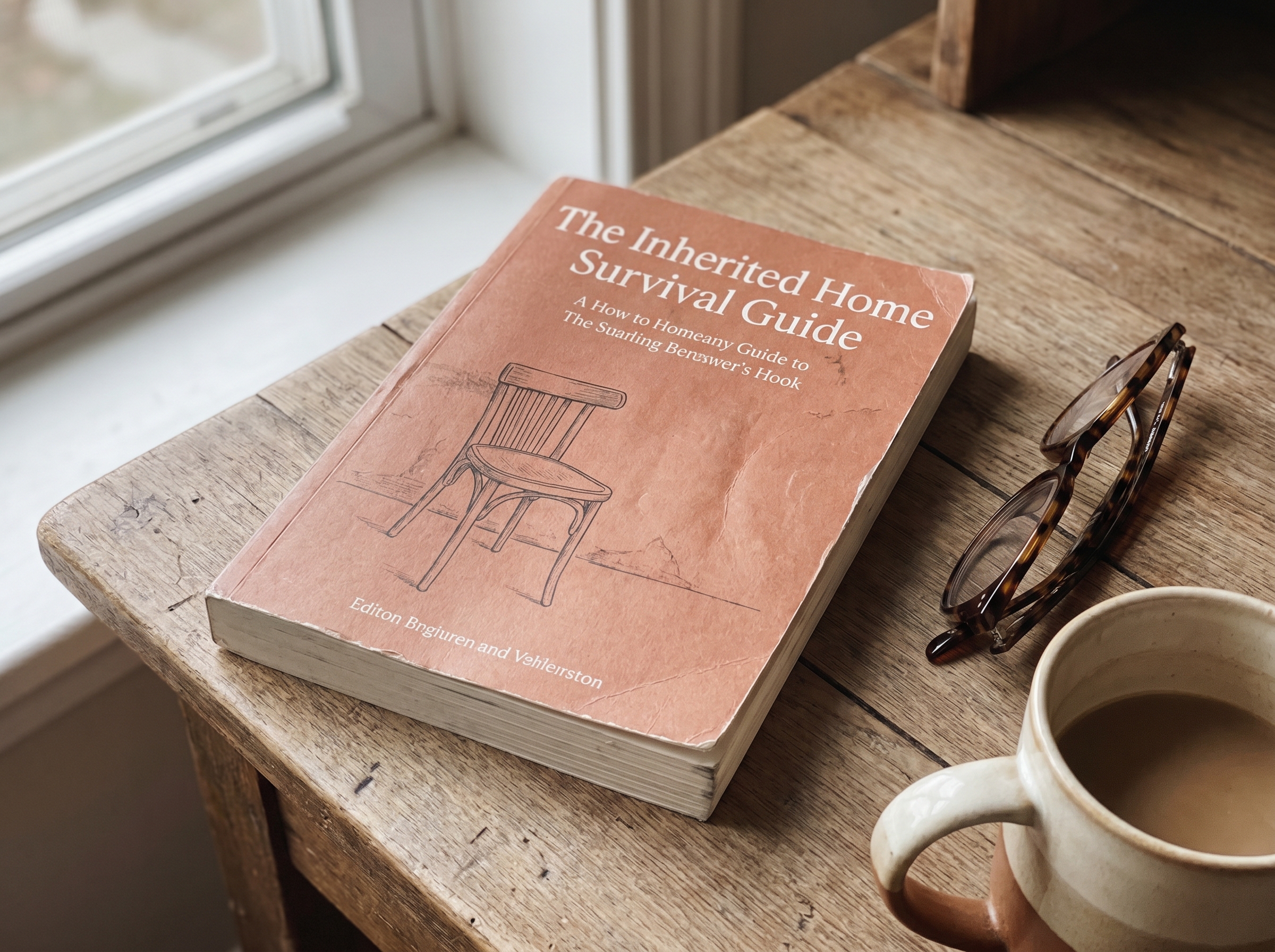
So I built the one I wished they'd had. The Inherited Home Survival Guide is roughly one hundred and forty pages of the playbook nobody hands you with the death certificate.
The credibility part matters, so here it is up front: the chapters covering law and tax are fact-checked by a practicing real estate attorney before anything ships. The chapters on selling — the cash-buyer trap, the as-is decision, the realtor interview — are reviewed by a probate-specialist realtor with the CPRES designation, the credential that matters in this niche. Both reviewers are named on the copyright page once their reviews are final.
I'm telling you these names will be there because I'd be furious if I bought a $19 book on my mother's house and the author was a publisher with no fact-checkers behind him.
I'm also telling you what I'm not. I'm not your attorney. I'm not your CPA. There are points in this book where the answer is "stop reading and call a probate lawyer," and the book is honest about which points those are. Chapter 6 is half decision tree.

The Inherited Home Survival Guide. Fifteen chapters and four appendices. About a hundred and forty pages.
Fifteen chapters and four appendices. About a hundred and forty pages. The structure follows the timeline you're actually living — first week, first month, the dead zone in the middle of probate, then the months around the sale itself.
Chapter 1 — You Inherited a House. Now What? The first forty-eight hours. What you have to do this week (very little, actually), what you do not have to decide yet (almost everything), and why the cash buyer who's calling already knows your name.
Chapter 2 — The Cash Buyer Trap. The single most important chapter in the book. The math on a typical cash offer: roughly 67.5 cents on the dollar against a home's after-repair value, per Clever Real Estate's 2024 survey of 764 investors. On a $400,000 house, the gap between the cash offer and a normal market sale is $50,000-$120,000. The chapter includes the one phrase to memorize when a buyer pressures you to sign by Friday, and the four specific scenarios where taking the cash actually is the right call.
Chapter 3 — The First 30 Days. The death certificates you need (more than you think), the bank accounts to freeze before someone else drains them, the mail to forward, and the appraisal that has to be ordered in the first thirty days or you'll owe capital gains tax on appreciation that happened before your parent died.
Chapter 4 — Picking Your Path. Sell now, sell later, rent it, keep it. A worksheet, not a sermon. Includes the math on what carrying costs actually look like over six months on a vacant inherited home.
Chapter 5 — The Sibling Conversation. The conversation that breaks more families than any other piece of this. How to have it, when to have it, what to say when your brother won't move out, what to say when your sister wants to "keep it for the memories." This is the chapter readers re-read most.
Chapter 6 — When to Call a Probate Attorney. Half decision tree, half plain-language explanation. There are scenarios where a $300 attorney consult saves you $30,000. There are scenarios where you don't need one at all. The book tells you which is which.
Chapter 7 — Hiring a Probate-Specialist Realtor. Most realtors have never done a probate sale. The ones who have hold the CPRES designation. Chapter 7 explains what that means, why it matters, and how to interview one. Appendix B is the ten-question script — pull it up on your phone during the call.
Chapter 8 — The Step-Up Basis (Without the Jargon). The single most expensive piece of tax law most heirs have never heard of. Worked examples on a $400,000 home that show exactly how a $60,000 tax mistake happens — and the one piece of paperwork (a date-of-death appraisal) that prevents it. Read this chapter before you sell.
Chapter 9 — Cleaning Out the House. Estate-sale companies, dumpster math, the things to look for before the dumpster (savings bonds in the freezer is a real category), and the digital cleanout almost nobody talks about.
Chapter 10 — As-Is vs Light Repairs. When a $4,000 paint-and-clean returns $25,000 at sale, and when it returns nothing. Open-market as-is discounts run from roughly 5% to 25% depending on condition and market — the chapter walks you through where you actually fall in that range.
Chapter 11 — If You're Renting It. The honest case for and against landlording an inherited home, the tax implications most people miss, and the property-manager interview if you decide to go ahead.
Chapter 12 — If a Relative Is Living in the House. The aunt who took care of Dad. The brother who's been "between things" since 2019. The stepparent on the deed. Legal options, conversation scripts, and the cash-for-keys math that almost always beats an eviction.
Chapter 13 — Closing the Estate. Final accounting. Final tax return. The paperwork that closes probate. The piece nobody tells you about — the year after the sale, when the 1099s show up and your CPA needs to know what the basis was.
Chapter 14 — The Stuff Nobody Warns You About. The HOA letter that arrives three weeks after the funeral. The auto-pay on Mom's Costco card that's still running. The small-claims court summons for a debt you never knew existed. A field guide to the surprises.
Chapter 15 — A Year From Now. The retrospective the book itself can't write. What three friends who've been through this told me they wish they'd known on day one.
Plus four appendices. Forty-plus verbatim phone scripts for the calls you have to make (banks, Social Security, IRS, utilities, credit cards, pension, DMV). A ten-question realtor interview script. A printable document checklist. And a six-branch decision tree for when you must call a probate attorney.
The bonus: The Sibling Buyout Toolkit ($27 value, free at checkout)
The hardest conversation in this whole process is the one with your siblings. So I built a separate toolkit for it, and you get it free when you check out today. Most readers tell us this is the single most-shared asset of the whole product — they email it to their siblings before the conversation, so everyone shows up to the kitchen table with the same vocabulary.
What's in the toolkit:
The Sibling Meeting Agenda — a one-page template that turns "we need to talk about the house" from an ambush into a meeting. Three sections, six questions, room for notes. Send it to your siblings two days before you talk.
The "Who Gets What" Decision Worksheet. Mom's ring. Dad's tools. The dining room set. The dollar-value items and the no-dollar-value items are both in the worksheet, because the no-dollar-value ones are where the actual fights happen.
The Buyout Math Calculator — a worksheet that walks through what a sibling buyout actually costs. Realtor fees you skip, taxes you don't, the appraisal, the loan your sibling will probably need. Plain numbers. No jargon.
Five Scripts for Hard Conversations. Verbatim language for the five hardest sentences: asking a sibling to buy you out, declining to buy them out, telling a sibling who's living in the house they need to leave, telling a sibling who wants to keep it that you can't afford to, and the one when somebody brings up Mom's will from 2002.
The Partition Action Reference Card. When all else fails, any co-owner can force a sale through partition. The card explains what this is, what it costs, what it takes, and why the threat of filing usually settles the matter before anyone actually has to file.
The "Difficult Sibling" Diagnostic. Six questions that tell you whether you're dealing with grief, fear, or actual bad faith — because the strategy for each one is completely different.
The toolkit is included with the book at checkout. No upsell page, no second click. It's there.
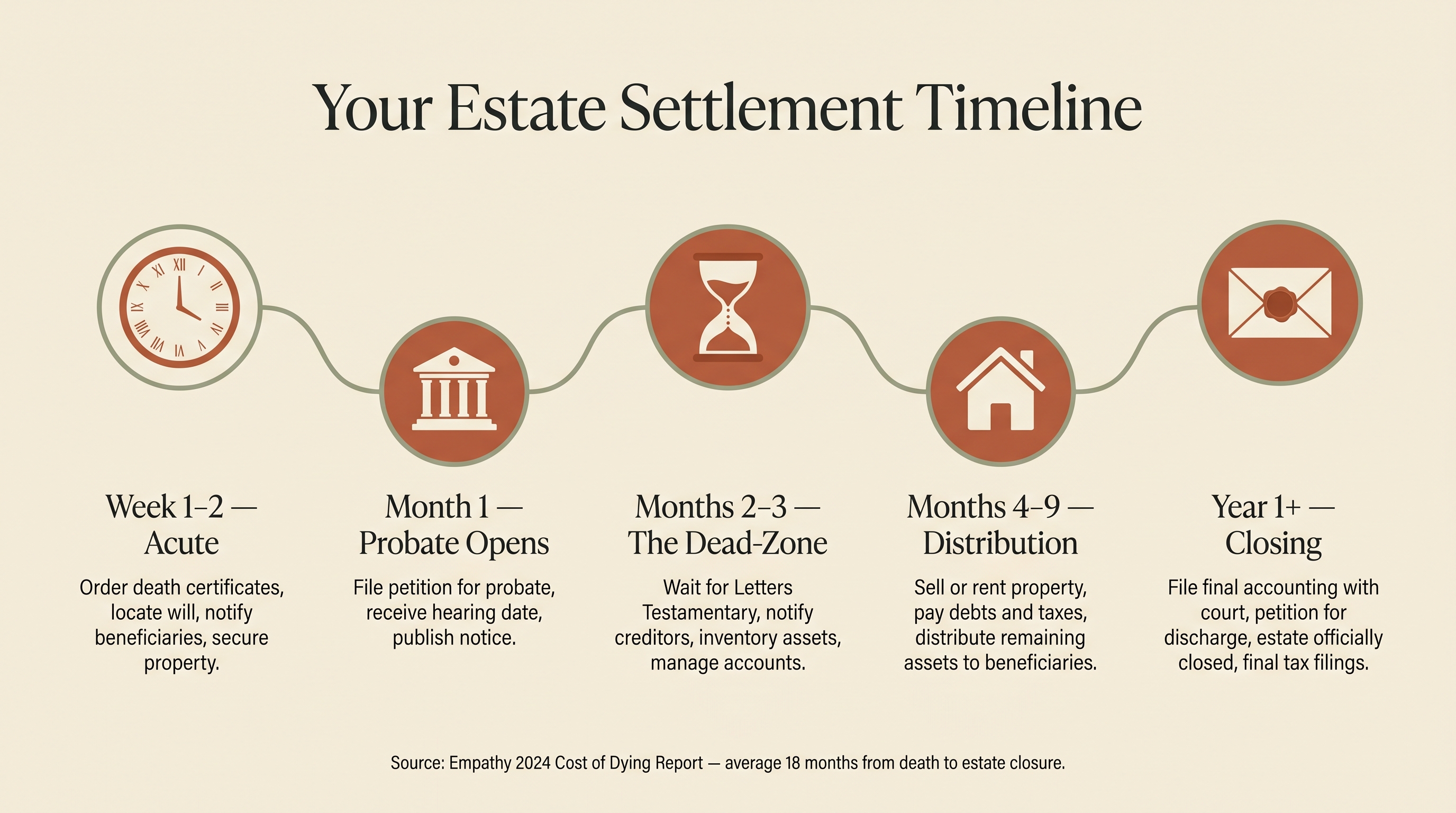
The Empathy 2024 Cost of Dying report (n=2,000 Americans, with Goldman Sachs): the average estate takes 420 hours of work spread over 18 months, with $12,616 in out-of-pocket costs to the family.
That's the timeline the cash buyer is exploiting when they offer to close in ten days. Eighteen months of paperwork, twelve thousand dollars of out-of-pocket expense, four hundred and twenty hours you don't have — versus an offer that makes it all stop on Friday.
Of course it's tempting. It is engineered to be tempting. The book is built to help you see what's actually on the other side of the temptation.
Every chapter that touches the law has been fact-checked by a practicing real estate attorney with probate experience. Every chapter that touches the sale process has been reviewed by a CPRES-credentialed probate-specialist realtor — the only realtor designation specifically focused on inherited property sales.
The phone scripts in Appendix A — forty-plus of them, for the calls you have to make to banks, Social Security, the IRS, utilities, credit card companies, pension administrators, and the DMV — were pressure-tested against real institutional call-center language, not invented at a desk. You will hear back what the script expects you to hear back.
Every statistic in the book is independently source-verified. The cash-investor number above (67.5% median offer) is the Clever Real Estate 2024 survey of 764 active residential investors — the industry-standard target taught at every wholesaling course. The 420 hours / 18 months / $12,616 figure is the Empathy Cost of Dying report, n=2,000.
If a number is in the book, it's sourced. If it's not in the book, it's because nobody has measured it yet.
$19 Less than an hour of a probate attorney's time
$50K–$120K On a $400K inherited home, the typical gap between a cash offer and a normal market sale
The book is $19.
That's less than one hour of a probate attorney's time. Most charge $200-$500 an hour, and the meter starts running when they pick up.
It's less than the date-of-death appraisal you have to order anyway. That's a $400-$700 line item the book teaches you to expense to the estate.
And it is roughly one-thousandth of the mistake the book is built to keep you from making. On a $400,000 inherited home, the gap between a typical cash-buyer acceptance and a normal market sale runs $50,000 to $120,000 — money that comes directly out of your inheritance.
If the chapter on step-up basis (Chapter 8) saves you from one $60,000 tax error, you've earned roughly 1,200x return on $19 — and that's a single chapter.
This is the cheapest part of the entire process. By a wide margin.
Sixty-day money-back guarantee. If the book doesn't help, email us and we refund the $19. Keep the PDF. No form to fill out, no "tell us why." I'd rather refund someone who didn't get value than keep $19 of an inheritance that didn't need this book.
The Inherited Home Survival Guide — $19, immediate PDF download. Includes the Sibling Buyout Toolkit ($27) free at checkout. See what's inside →
Somebody you loved is gone. The house is now yours. The phone is starting to ring, the mail is starting to arrive, and the people calling have done this a hundred times against your zero.
There is a version of the next nine months where you make every decision feeling rushed, exhausted, and out-of-your-depth, and you end up settling for thirty cents less on the dollar than you should have. That's the default outcome. That's the one the cash buyers built their business around.
And there is a version where you have a hundred and forty pages of plain-language playbook on the kitchen table, a phone script for every call you have to make, and a sibling toolkit that turns the hardest conversation into a meeting with an agenda.
Get The Inherited Home Survival Guide
$19. PDF, immediate download. Includes the Sibling Buyout Toolkit ($27) free at checkout. 60-day refund guarantee.
Read It Before You Sign →60-day money-back guarantee • Instant PDF download